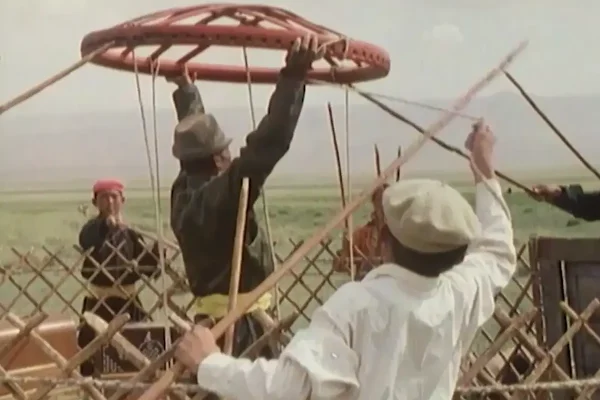
In 1974, a Western television crew filmed the first documentary introducing international audiences to Mongolia’s nomadic life. This six-minute segment follows a herding family during a seasonal move, showing how their household belongings—including the yurt—are packed onto four camels, transported across the steppe, and assembled again at a new location.
The footage highlights the practical design of the traditional yurt. Each component is compact and manageable: the lattice wall sections, roof poles, crown, and felt coverings are bundled and loaded in balanced sections for transport. One noticeable feature is the low wall height. The yurt appears to be approximately 50 cm (about 20 inches) shorter than the short-wall models we produce today. The reduced height likely made transport easier, lowered overall weight, and improved stability in strong winds.
Another visible difference is the absence of a separate waterproof layer. The main covering is the felt, reflecting the materials traditionally used at the time. While felt provides insulation and some moisture resistance, it does not offer the level of weather protection available with modern membranes. The film provides not only a cultural record, but also a technical reference point for understanding how contemporary yurts have evolved—balancing traditional form with improved materials and performance.